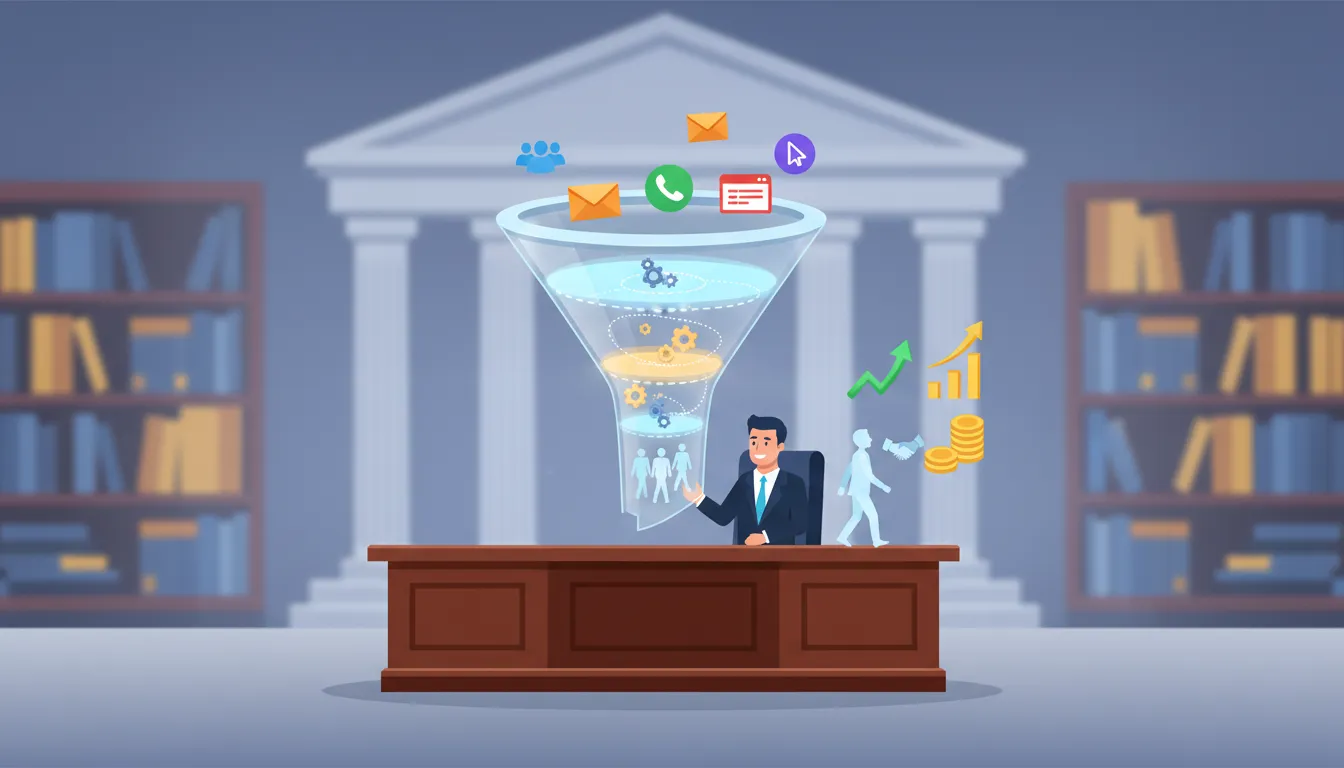
Law firms are drowning in competition. Whether you run a solo practice or a boutique family law firm, the problem isn’t just finding leads — it’s turning those leads into paying clients without wasting ad dollars. This post breaks down a full-funnel approach that connects paid acquisition to intake, CRM automation, follow-up, and the metrics that actually matter: customer acquisition cost (CAC), lifetime value (LTV), and true ROI.
Why “leads” alone are misleading
Most agencies still sell by counting leads: number of form fills, calls, or contact requests. That’s an outdated metric. What matters is whether those leads convert into clients and revenue. You can buy hundreds of leads a month and close none if intake and follow-up are weak.
“You really need to educate your customer on the true ROI of a campaign… determine conversion rates on the back end.”
Start thinking in terms of the entire customer journey — from search to signed retainer. That requires instrumentation: a CRM that ties each inbound touch to outcomes, automated follow-ups that re-engage prospects, and regular reporting that translates leads into revenue.
Start with high-intent channels: Google Local Service Ads (LSA)
For law firms — especially divorce and family law practices — Google Local Service Ads are often the fastest path to qualified calls. LSAs capture high-intent searches like “divorce attorney near me” and surface businesses directly in the search results.
LSAs convert well because the searcher is ready to act. Two practical things to remember:
- Be ultra-local. Target only the radius where you genuinely serve clients. Trying to appear in areas where you have no presence can hurt performance.
- Optimize your Google Business Profile. LSAs and local packs reward accurate business data and strong review profiles.
Move beyond media buys: the Caseflow concept
Generating the initial contact is only step one. A winning system takes that contact, qualifies it quickly, and books a consult on the attorney’s calendar. That’s the idea behind a full-funnel system such as Caseflow: media buy + CRM + intake + automated follow-up.
Key pieces of the flow:
- Paid acquisition (LSA or Google Ads) to drive high-intent calls.
- Centralized call intake that records and pre-qualifies prospects before passing them to the attorney.
- CRM automation that tracks conversion rates, revenue, and close rates so you can calculate CAC and LTV.
- Automated re-engagement (texts, emails, call attempts) to prevent cold leads from disappearing.
Why intake speed matters
If you don’t respond immediately, odds are the prospect moves on. Rapid follow-up increases booking rates dramatically. In an attention-short world, getting back to a lead within minutes can be the difference between retaining a potential client and losing them to the next firm.
“If you don’t get back to a customer or a lead right away, they’re gone.”
CRM choices and what to track
You don’t need the most expensive CRM — you need one that integrates intake, call tracking, and reporting. Platforms like GoHighLevel are popular for agencies because they let you customize automation, route calls, and track revenue down to the campaign.
Essential KPIs every firm should track:
- Leads generated by channel
- Contact-to-booking rate (how many leads turn into scheduled consults)
- Close rate (how many consults convert to paid clients)
- Customer acquisition cost (CAC)
- Lifetime value (LTV) of a client
- Intake response time (target: within minutes)
Reviews: the ranking and conversion multiplier
For local search and LSAs, reviews are often as important as your website. A solid review profile improves visibility, trust, and click-through rate.
Practical review strategy:
- Reactivation campaigns: Ask past clients to leave reviews via an automated email or SMS sequence.
- Post-close prompts: Trigger a review request once a matter is closed via your CRM workflow.
- Volume and authenticity: A healthy mix of recent, genuine reviews beats a small cluster of suspiciously perfect ratings.
Interesting note: studies and platform heuristics often favor a realistic rating range (for example, 4.0–4.7) over a perfect 5.0, because near-perfect scores can look suspicious to users and platforms alike.
Paid ads vs SEO: how and when to scale
Paid channels provide immediate visibility. SEO builds long-term brand presence. The best approach combines both:
- Start paid to generate cash flow and learn what converts. Paid search reveals the exact terms prospects use and the messaging that works.
- Optimize local profiles and begin an SEO effort while paid is running. Expect SEO to take months to ramp (3–9 months depending on competition).
- Keep paid running while organic gains grow. Organic should supplement, not replace, paid when you need predictable lead flow.
Common intake pitfalls and how to avoid them
Many firms lose clients not because of poor ads but because of operational leaks:
- Slow or inconsistent follow-up
- No recording or tracking of inbound contacts
- Poorly defined qualification criteria
- Calendars that lack available slots
Fix these with a documented intake script, a short pre-qualification questionnaire, and calendar integrations so appointments flow directly into the attorney’s schedule.
Questions every law firm should be asking
Use these to evaluate your marketing and operations:
- What is our revenue goal and how many clients do we need to hit it?
- What is our current close rate from lead to client?
- What is our CAC and the LTV of a client?
- How fast does our intake team respond to new leads?
- Which campaigns are producing the best ROI?
Putting it together
A modern lead-gen strategy for law firms is not just about ad spend. It is a coordinated system that combines high-intent acquisition channels, local reputation management, immediate intake, CRM-driven automation, and outcome-based measurement. When those elements are connected, you stop counting superficial leads and start measuring real revenue.
If you run a family law or divorce practice, focus first on high-intent local channels, tighten your intake process so callbacks happen in minutes, automate post-interaction follow-up, and instrument your CRM to report CAC and LTV. Those changes move you from a feast-or-famine referral model to predictable growth.
Quick checklist to implement this week
- Audit Google Business Profile and request recent client reviews.
- Run a small LSA or Google Ads test ($100–$500) to validate demand and messaging.
- Implement a short intake questionnaire and routing script.
- Set up CRM tracking for leads → bookings → closed cases.
- Measure CAC vs LTV and set a target close rate to reach revenue goals.
Data and speed win. Track the outcomes that matter, and structure your marketing around converting high-intent prospects into scheduled consultations and closed matters.